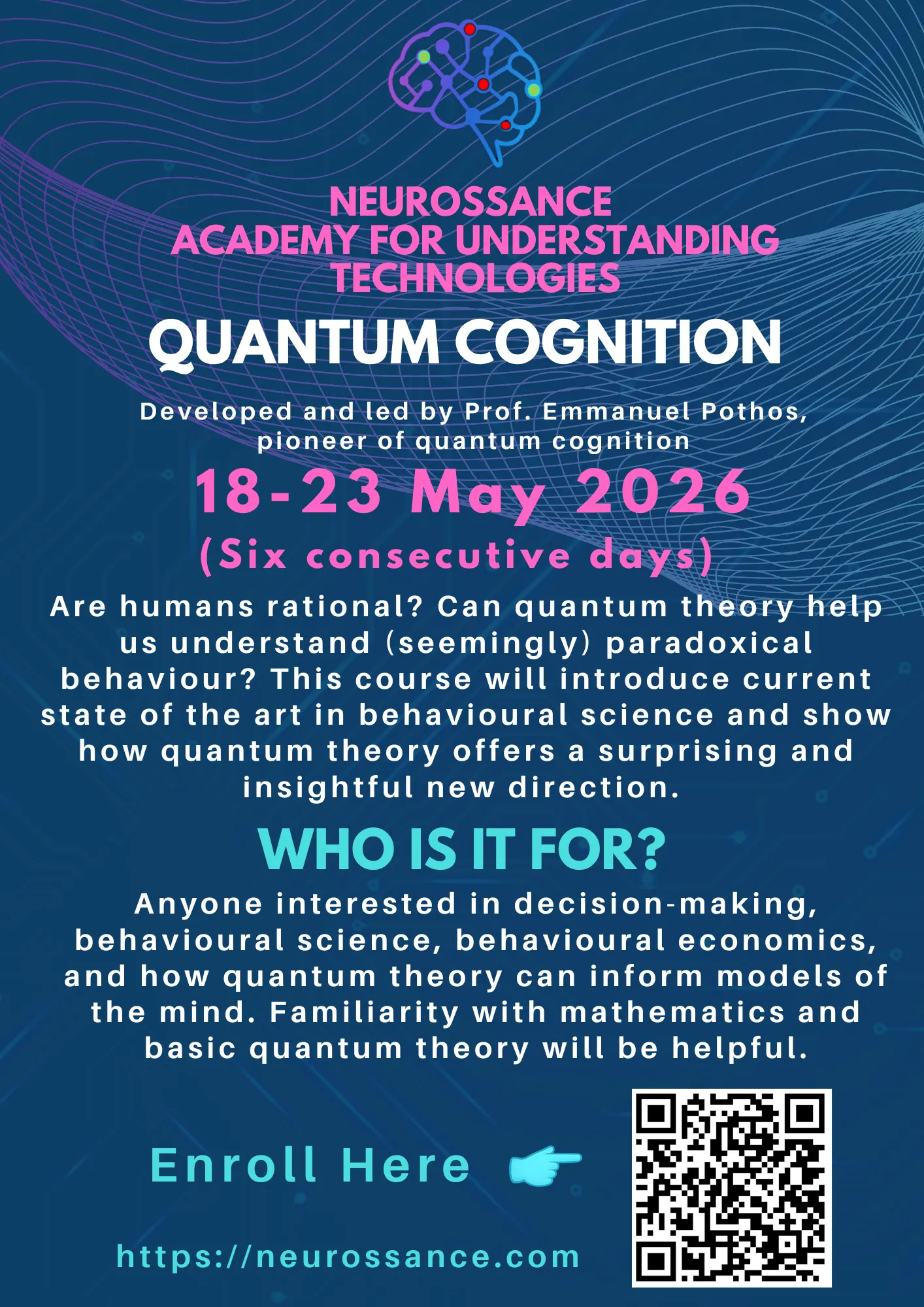
The NEUROssance Academy for Understanding Technologies (NAUT) opens enrolment for Quantum Cognition, a programme developed and led by Prof Emmanuel Pothos, a pioneer of the field. It runs over six consecutive days, from 18 to 23 May 2026.
Are humans rational? Can quantum theory help us understand (seemingly) paradoxical behaviour? The course introduces the current state of the art in behavioural science and shows how quantum theory offers a surprising and insightful new direction.
- Dates
- 18 to 23 May 2026, six consecutive days
- Format
- Six sessions, one a day, in a cohort of up to 30
- Length
- Six hours in all
- Fee
- £400; 50% off for students
Who is it for?
Anyone interested in decision-making, behavioural science, behavioural economics, and how quantum theory can inform models of the mind. Familiarity with mathematics and basic quantum theory will be helpful.
What you will learn
Over the six sessions you will:
- See why classical probability was assumed to govern human decision-making, and where it breaks down
- Explore the paradoxes that have shaped modern cognitive and decision theory
- Learn the motivation behind quantum approaches to cognition and examine early foundational models
- Work through the mechanics of key quantum cognitive models
- Understand dynamical approaches to modelling mental processes
- Explore real-world applications, from organisational psychology to legal decision-making
- Engage with current developments and open challenges in the field
The six sessions
- Session 1
- Classical probability theory in psychology: rationality and paradoxes.
- Session 2
- Can ‘rain and snow’ be more likely than ‘snow’? Quantum theory in cognition.
- Session 3
- How quantum decision models are built.
- Session 4
- Dynamics.
- Session 5
- Applications: legal decision-making and organisational psychology.
- Session 6
- State of the art and future directions.